The metal manufacturing industry relies on various machines and technologies to transform raw materials into usable products. Rolling Mill Machine is one of the most important pieces of equipment used for shaping and reducing the thickness of metal. Rolling mills play a crucial role in producing metal sheets, strips, rods, bars, structural sections, and tubes used in construction, automotive, engineering, and industrial applications.
What Is a Rolling Mill?
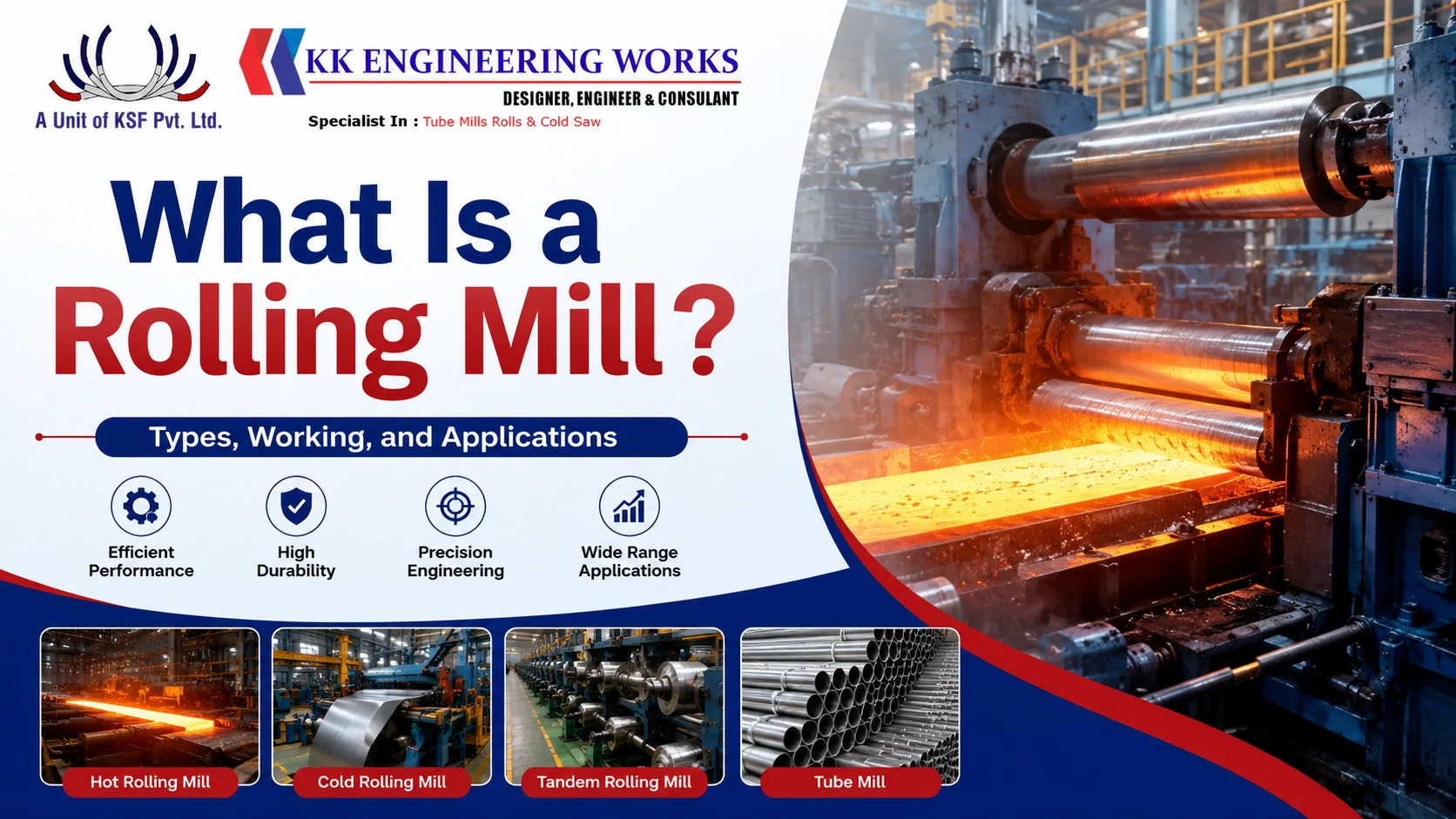
Rolling mill is a machine or a series of machines that apply compressive forces to metal stock by passing it through rotating rolls. The pressure exerted by the rolls reduces the thickness of the metal and modifies its shape according to specific requirements.
Rolling mills are commonly used to process steel, aluminum, copper, brass, and other metals. The process can be carried out under hot or cold conditions depending on the desired properties of the finished product.
By continuously reducing the cross-sectional area of the metal, rolling mills enable manufacturers to produce products with excellent dimensional accuracy and consistent quality.
Importance of Rolling Mill Machine in Modern Manufacturing
Rolling mills are vital for industries that require large quantities of metal products with uniform dimensions and high-quality finishes. These machines contribute significantly to production efficiency and material utilization.
Some key reasons why rolling mills are important include:
- High-volume production capability
- Consistent product dimensions
- Improved material strength
- Better surface finish
- Reduced manufacturing costs
- Enhanced production efficiency
- Minimal material wastage
Working Principle of a Rolling Mill
The working principle of a rolling mill is relatively simple. Metal stock is fed between two or more rotating rolls. As the metal passes through the gap between the rolls, compressive forces reduce its thickness and alter its shape.
The rolling process can be performed in multiple stages to achieve the desired dimensions. Each pass through the rolls further refines the material until the required specifications are obtained.
Rolling Mill Process: Basic Steps
Material Preparation
Raw metal billets, slabs, blooms, or coils are prepared before entering the rolling mill.
Feeding
The material is introduced into the rolling stand where rotating rolls grip and pull the metal forward.
Thickness Reduction
Pressure generated by the rolls compresses the material and reduces its thickness.
Shaping
The rolls shape the material into the required profile, such as sheets, strips, rods, or structural sections.
Finishing
The finished product undergoes cooling, cutting, coiling, or additional processing before being dispatched for use.
Types of Rolling Mills
Different types of rolling mills are used depending on production requirements and material specifications.
1. Two-High Rolling Mill
The two-high rolling mill consists of two rolls rotating in opposite directions.
Features
- Simple design
- Easy operation
- Suitable for basic rolling operations
Applications
- Steel processing
- Small manufacturing units
- Educational and research facilities
2. Three-High Rolling Mill
This rolling mill uses three rolls positioned vertically.
Features
- Continuous rolling operation
- Improved productivity
- Reduced handling time
Applications
- Medium-scale steel processing
- Structural section production
3. Four-High Rolling Mill
A four-high rolling mill includes two smaller working rolls supported by two larger backup rolls.
Features
- Greater precision
- Reduced roll deflection
- Suitable for thin materials
Applications
- Sheet metal manufacturing
- Precision steel processing
4. Cluster Rolling Mill
Cluster rolling mills use multiple backup rolls to support smaller work rolls.
Features
- Excellent dimensional accuracy
- Suitable for extremely thin materials
- High-quality surface finish
Applications
- Stainless steel production
- Specialty metal processing
5. Tandem Rolling Mill
A tandem rolling mill consists of several rolling stands arranged in sequence.
Features
- Continuous processing
- High production speed
- Excellent efficiency
Applications
- Large-scale steel production
- Automotive sheet manufacturing
Hot Rolling vs Cold Rolling
Rolling operations are generally classified into two categories.
Hot Rolling
Hot rolling is performed above the metal’s recrystallization temperature.
Advantages
- Easier metal deformation
- Lower force requirements
- Suitable for large sections
- High production rates
Applications
- Structural steel
- Rails
- Heavy industrial products
Cold Rolling
Cold rolling is performed at room temperature.
Advantages
- Better surface finish
- Improved dimensional accuracy
- Enhanced mechanical properties
- Tight manufacturing tolerances
Applications
- Automotive components
- Electrical equipment
- Precision engineering products
Applications of Rolling Mill Plant
Rolling mills are used across numerous industries due to their ability to produce metal products efficiently and accurately.
Construction Industry
Rolling mills manufacture structural steel sections, reinforcement bars, beams, channels, and other building materials used in infrastructure projects.
Automotive Industry
The automotive sector uses rolled metal sheets and components for vehicle bodies, frames, and engine parts.
Tube and Pipe Manufacturing
Rolling mills play a critical role in producing tubes and pipes used in industrial, commercial, and residential applications.
Electrical Industry
Electrical equipment manufacturers use rolled metal strips and sheets for transformers, motors, and switchgear components.
Aerospace Industry
Aircraft manufacturers require precision-rolled materials for lightweight and high-strength components.
Engineering Sector
Machine components, industrial equipment, and fabricated structures rely heavily on rolled metal products.
Benefits of Using Rolling Mills:
Rolling mills provide numerous advantages that contribute to efficient metal manufacturing.
Increased Productivity: Rolling mills can process large volumes of material quickly, making them ideal for mass production.
Consistent Quality: Advanced rolling technology ensures uniform dimensions and superior product consistency.
Improved Mechanical Properties: The rolling process enhances material strength and structural integrity.
Better Surface Finish: Rolling produces smooth surfaces suitable for further processing or direct use.
Cost Efficiency: High production rates and reduced material waste contribute to lower manufacturing costs.
Versatility: Rolling mills can process different metals and produce various product shapes and sizes.
KK Engineering Tube Roll Mill Manufacturers
KK Engineering, Tube Roll Mill Manufacturers is a leading provider of advanced tube mill and rolling mill plant for the metal processing industry. The company specializes in manufacturing high-performance machinery designed for precision, efficiency, and durability.
Our rolling mill equipment is manufactured using premium-quality materials and modern engineering technology to ensure reliable performance in demanding industrial environments. With a strong focus on innovation, quality control, and customer satisfaction, we offer customized machinery designed to meet the specific production requirements of various industries, helping manufacturers improve productivity and achieve superior product quality.
Conclusion
Rolling mills are indispensable machines in the metal manufacturing industry. They provide an efficient method for reducing metal thickness, improving material properties, and producing a wide range of products used across construction, automotive, aerospace, electrical, and engineering sectors.
With advancements in rolling technology, manufacturers can achieve higher productivity, greater accuracy, and better product quality than ever before. For businesses looking for reliable rolling mill and tube mill solutions, KK Engineering Tube Roll Mill Manufacturers offers advanced machinery designed to deliver long-term performance, operational efficiency, and outstanding manufacturing results.